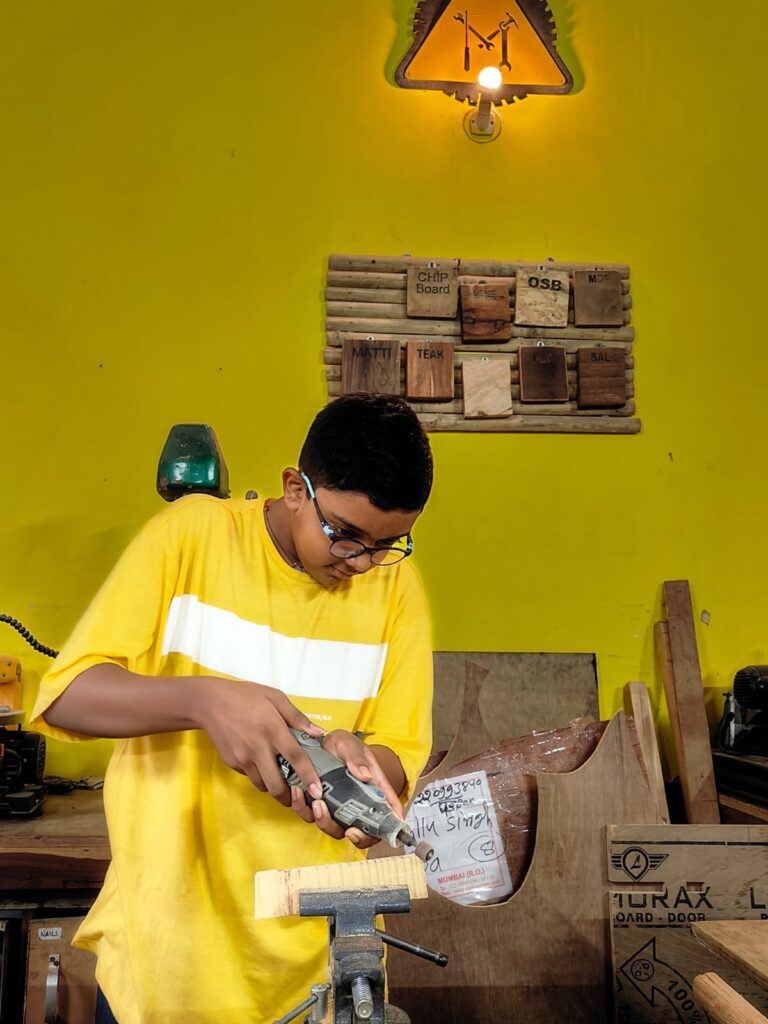
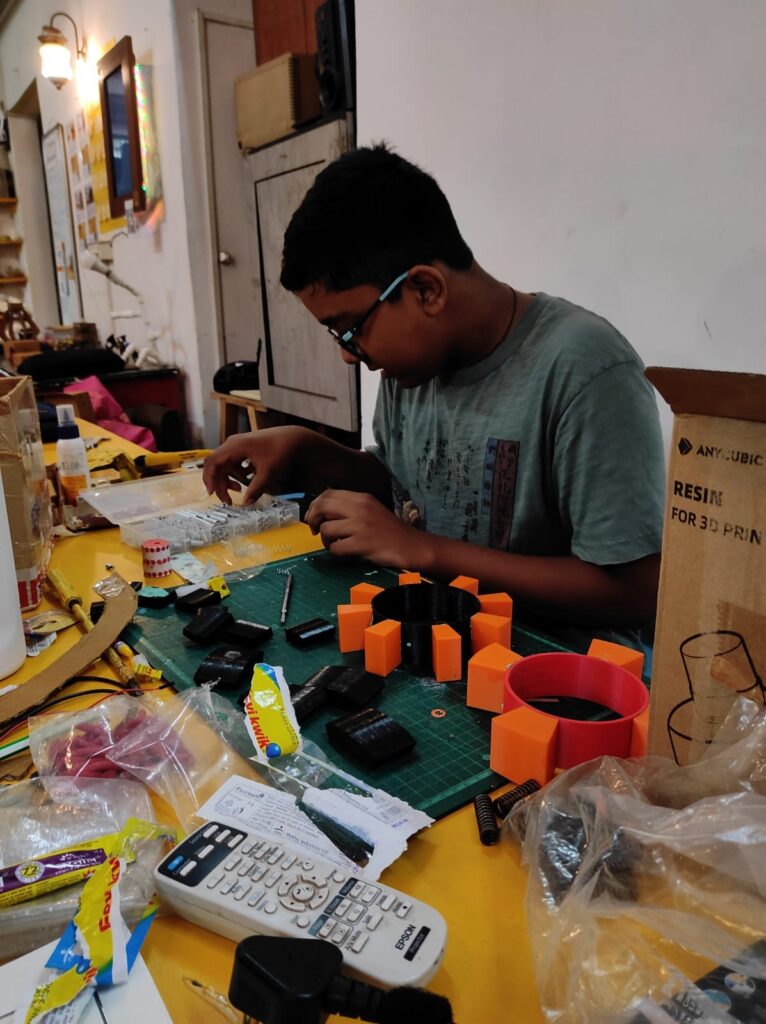
We worked on Terraflex wheel as the Maker Project for the Maker’s Asylum Summer Residency Program, our team included Siddharth Kannan, Sai Pranav Gandhi and Akiv Shetty.
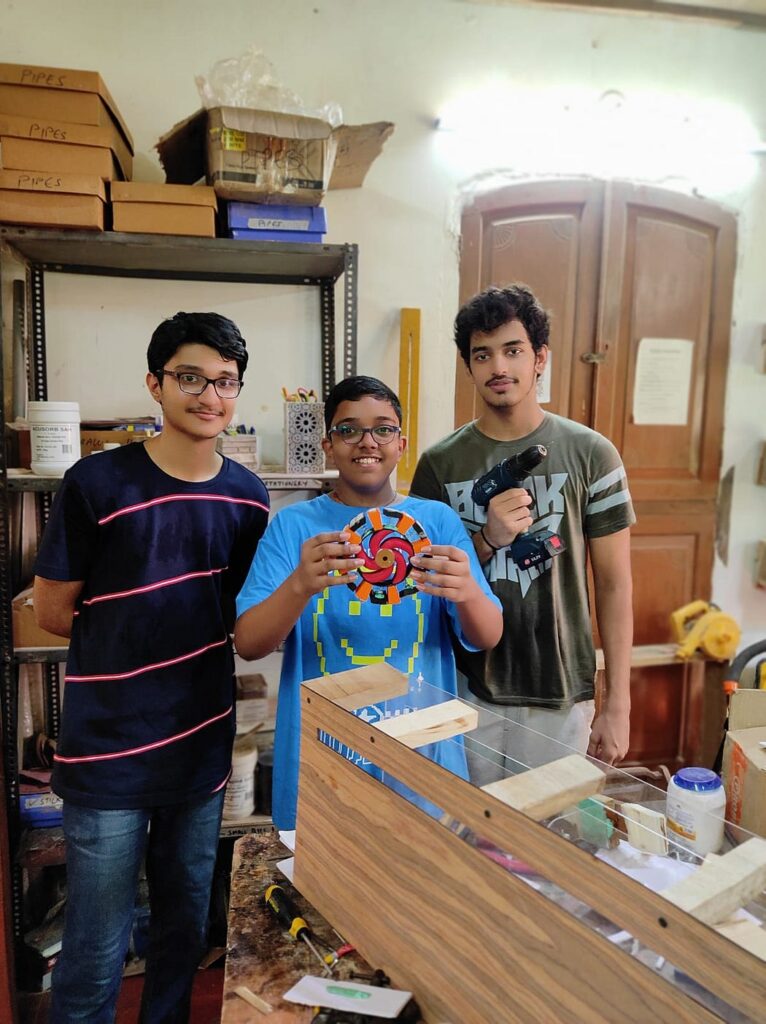
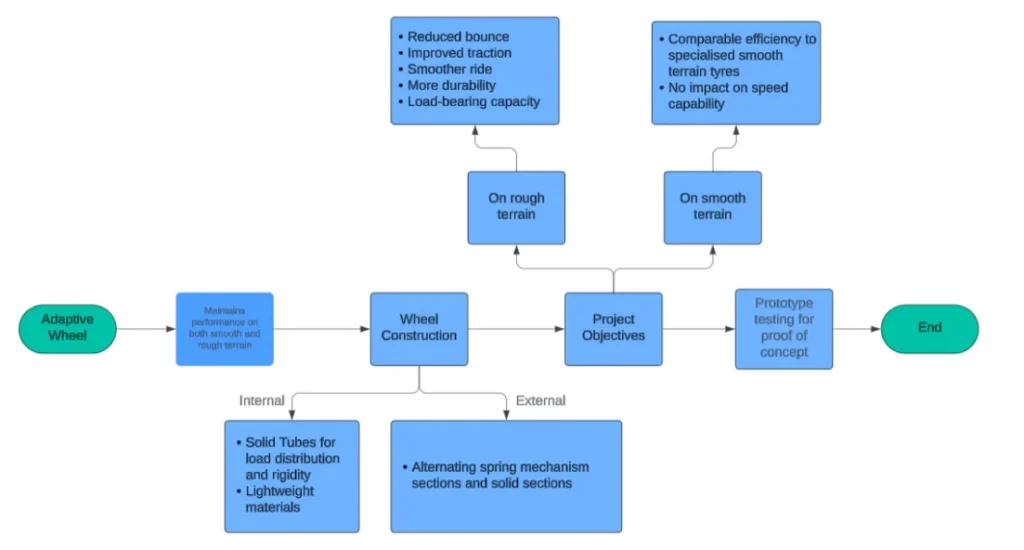
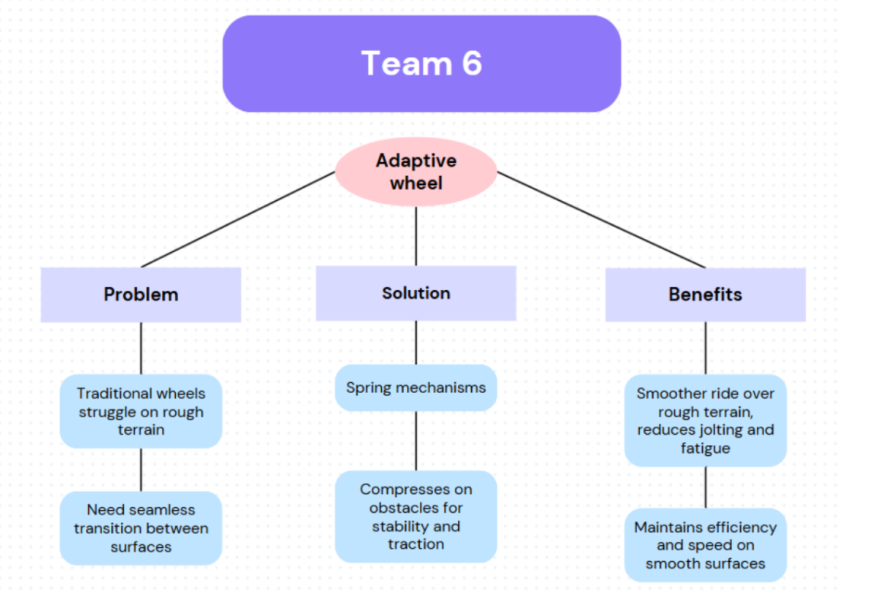
Our project introduces an innovative wheel designed for smooth and rough terrains. It features springs that adapt to surface irregularities. When encountering obstacles like rocks, the springs compress for stability and traction, ensuring a smoother ride on rough terrain while maintaining efficiency and speed on smooth roads.
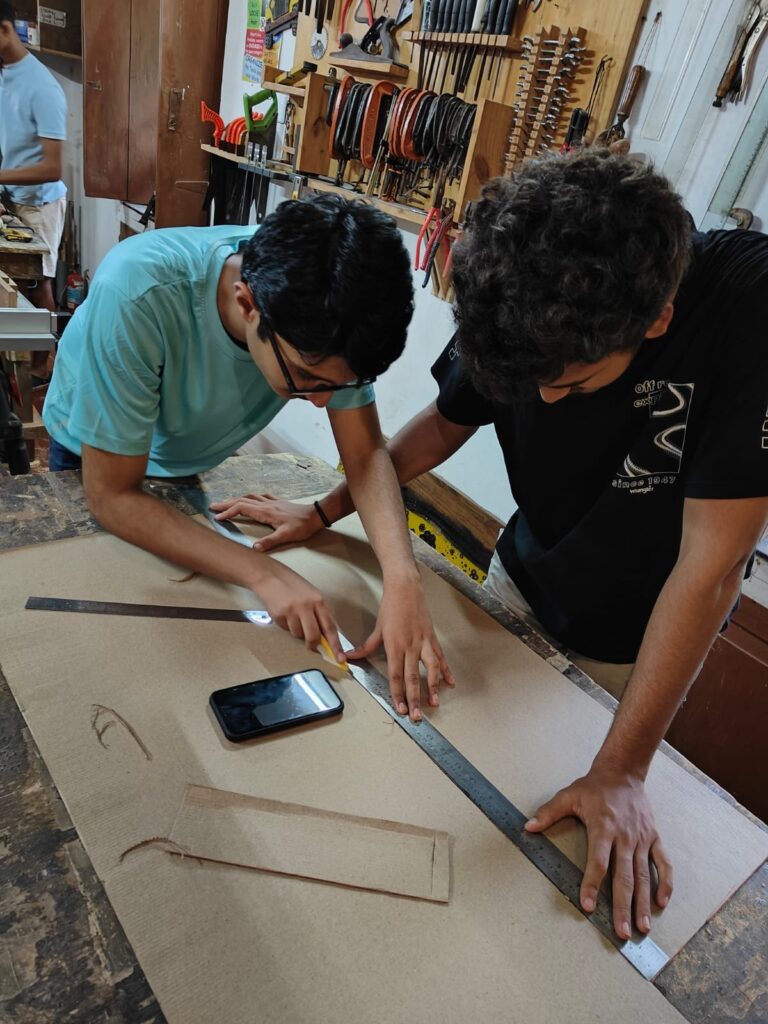
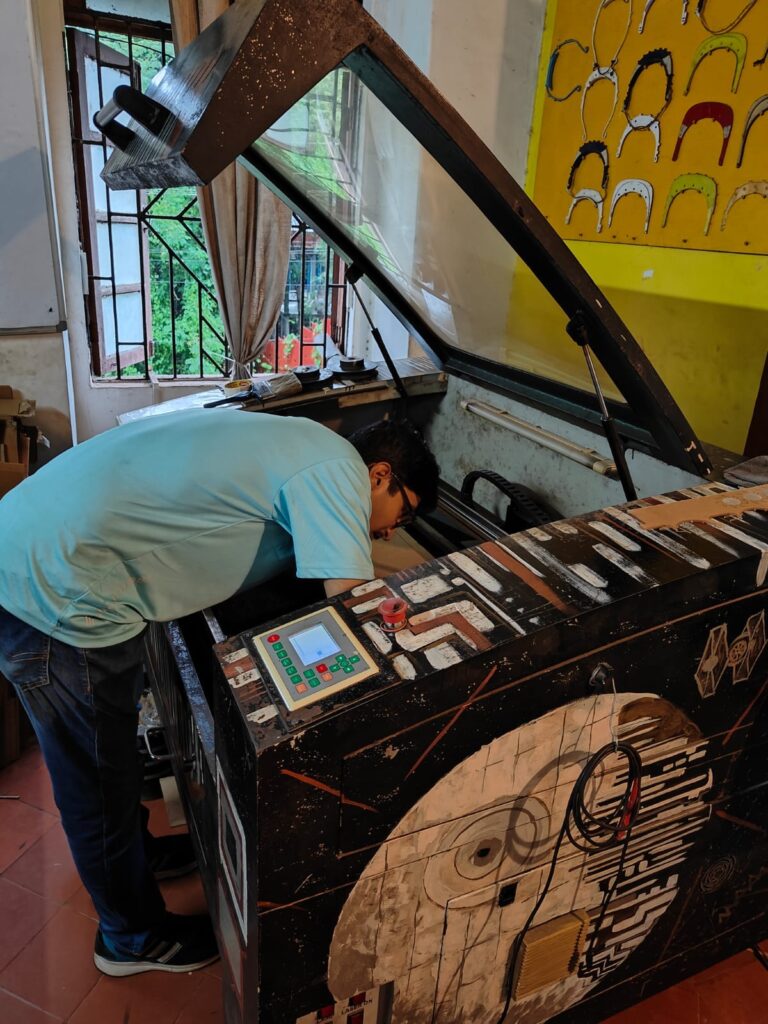
As a part of our 7 day residency at Maker’s Asylum in Goa, we learnt various skills like woodworking, laser cutting and 3D printing. These skills were essential to making the wheel since our project is purely mechanical and involves no coding.
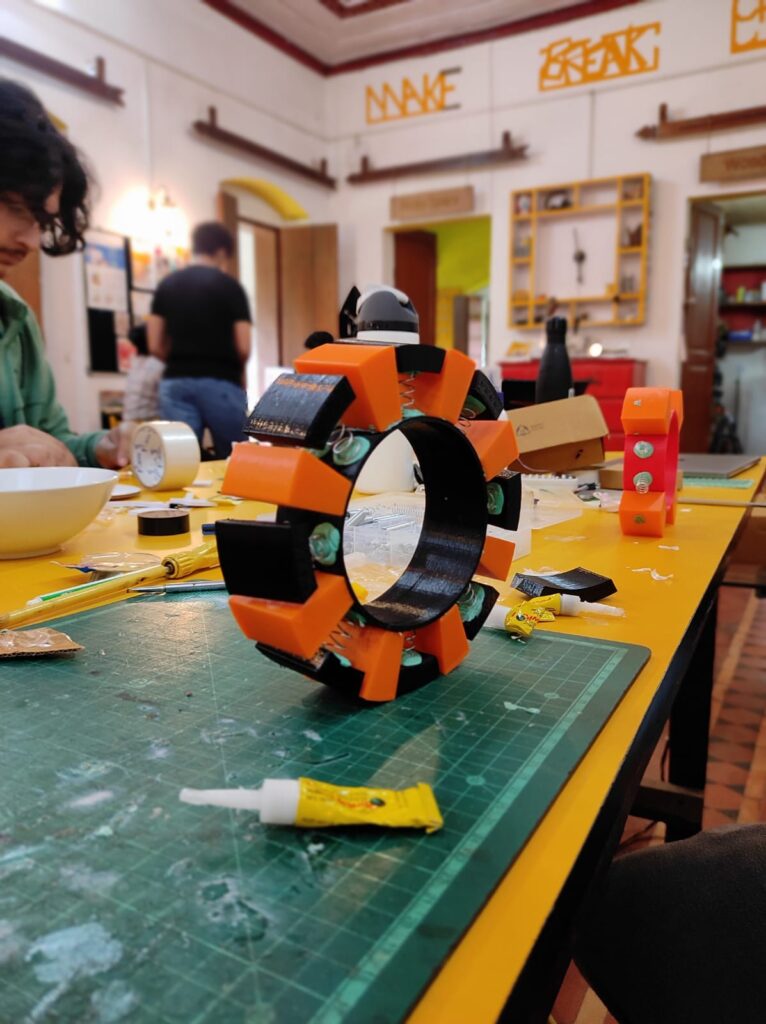
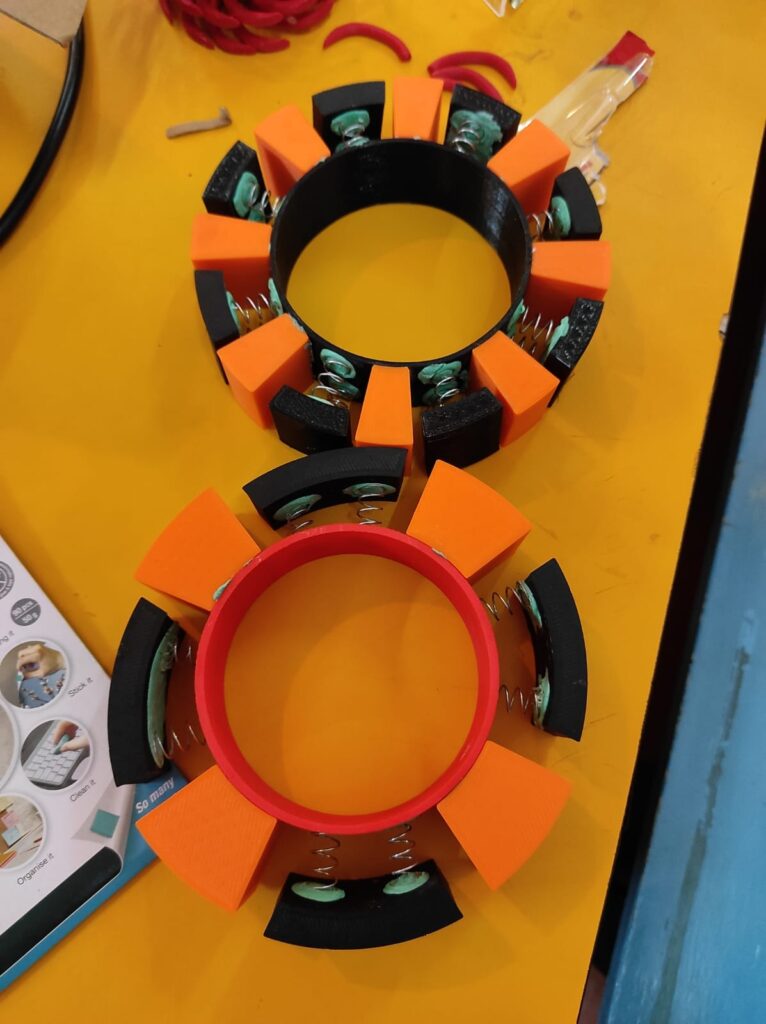
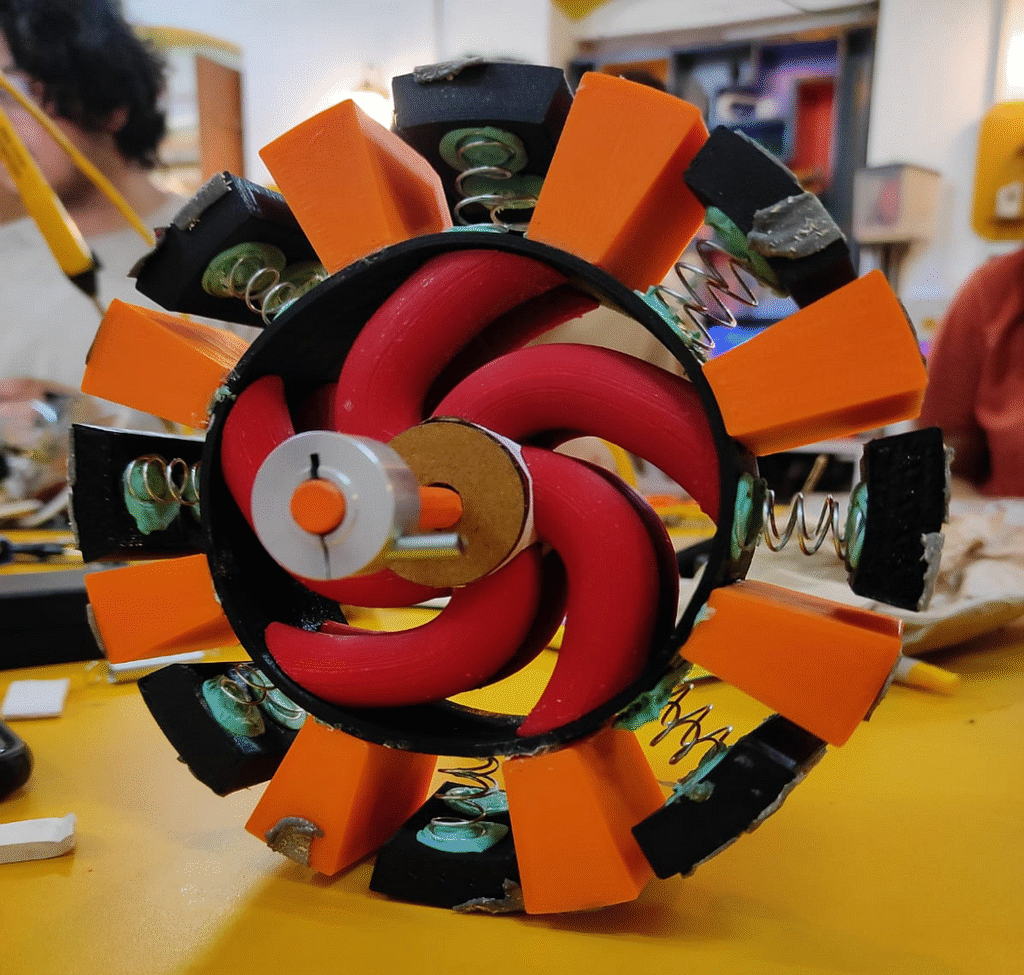
Our final project is a scale model 150mm diameter wheel with alternating spring and solid sections. The spring sections will absorb any terrain irregularities like rocks and broken ground, and the solid sections will maintain the same regular rotation on smooth roads. Most of the wheel is 3D printed. The 3D printed part sizes can be obtained from the CAD files “Assembly final” or “Wheel made as one.”
Problem statement
Our project introduces an innovative wheel designed to enhance performance across both smooth and rough terrains. Traditional wheels often struggle with stability and traction on uneven surfaces, leading to discomfort and reduced efficiency.
Solution
Our wheel addresses these challenges by integrating spring mechanisms that allow the wheel to dynamically adjust to surface irregularities. TerraFlex provides a smoother experience while maintaining efficiency on paved roads.
Objectives
Create a wheel that is equally efficient on smooth roads and rough terrain.
Ensure stability by using spring suspensions inside the wheel, as opposed to spokes.
Avoid punctures as the wheel is airless
Constraints
The materials used to make the solid sections must be able to withstand the weight of the car, along with jerks during motion.
The springs must compress adequately to allow smooth motion on rough terrain
The spring sections must not cause bouncy motion on smooth roads.
For our prototype, the weight must be accurately simulated as 50–70N
Chronological Progress
Pre-residency (online)
We brainstormed different techniques and mechanisms which can help the wheel maintain stability without having to rely on external vehicle suspension. We took inspiration from the PATS wheel and NASA’s airless wheels for Mars missions. After researching different types of past innovative wheel designs, we decided on creating a wheel with alternating spring sections and solid sections. We designed the CAD models of the wheel on Fusion 360 during online team meetings.
Residential
We designed the testing track to test our wheel prototype on. We finalized on a 850mm length track with a slider and block attached above the wheel to act as the weight of the car. After comparing the ratio of the size of our prototype to the size of an actual wheel, we determined the weight acting on the wheel to be 70N. We then laser-cut the first-version of our bracket for the test track, and cardboard side plates for our side-track and tested the wood block as a slider. After multiple trials, we determined the slider dimensions to be 20mm x 70mm x 18mm. We then got our CAD models 3D printed with ABS, TPU and PLA. We assembled the wheel using super glue to stick the 3D printed parts together. We printed 5 different inner pieces and tested each one of them. We finally decided on using a Large Curve piece. Our final design used 8 solid sections and 8 spring sections with a total of 16 20mm springs.
Materials Used
4 x Cylinder — 3D Printed ABS — diameter 30mm and thickness 35mm. With a hole in the middle.
24 x Springs — length of 20mm and outer diameter of 10mm. Wire thickness 0.5mm
3D printing material — PLA 168g and 109g TPU and 304g ABS
850mm x 300mm Plywood with thickness 3mm with a 750mm x 17 mm slit for side plate
850mm x 300mm clear acrylic with thickness 1.7mm with a 750mm x 17 mm slit for side plate
20mm x 70mm x 160mm Plywood block as slider
150mm x 850mm — Sunboard x 2 for base of track
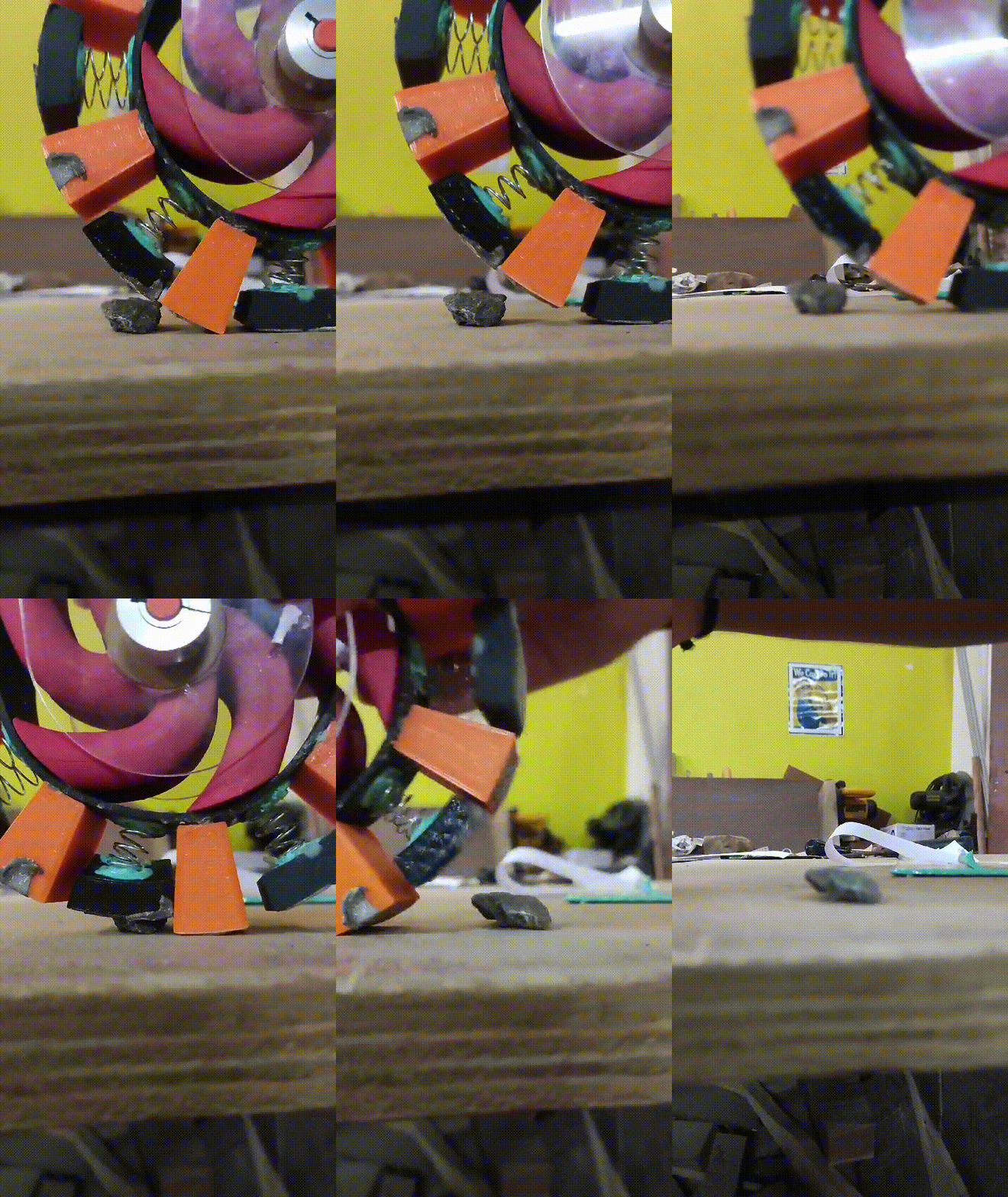
The video of the presentation we made at the Makers Asylum
The project files are available here
Documentation is available at:
The project has been submitted as part of the Open Source Hardware Association (OSHWA). and has been granted licence IN000054 as seen on the OSHWA website
We would like to thank the Team of mentors at the Makers Asylum for providing the fantastic facilities, mentorship and community to make this project possible. Shout out to Vaibhav Chhabra Sir, Shivam Kulkarni Sir, Santan Sir, Ayush sir, Nidhi Dugar Ma’am and Richa Shrivastava Ma’am.
We would like to thank the Team of mentors at the Makers Asylum for providing the fantastic facilities, mentorship and community to make this project possible. Shout out to Vibhav, …
The project has been already showcased by OSHWA on the www.hackster.io website