Engineering Inspiration Award: Team RFactor 6024’s Success
This year marked my second season with Team RFactor 6024, a high school robotics team based in Mumbai that competes in the FIRST Robotics Competition (FRC). Even though I live in Goa, I traveled to Mumbai during holidays to work with the team. When I was there, I spent 16 to 18 hours a day at the lab, doing everything from coding and building the robot to wiring and designing it on the computer. My biggest roles were programming the robot and being the main driver during matches—responsibilities that played a big part in our journey to the Engineering Inspiration Award.
How Our Robot Worked
Our robot was built with a modular system that broke it down into smaller parts. Each subsystem—wheels, arm, and intake—had its own dedicated code that defined its behavior. A central control layer then connected everything and responded in real time when I pressed buttons on the controlle
The Wheels: Swerve Drive
Most robots just drive like a car. Ours used something called swerve drive. It lets the robot move in any direction—forward, backward, sideways, or spin. It can do all this at the same time. Imagine being able to slide in any direction without turning your body. That’s what swerve drive does.
We used some math to determine the direction each wheel should point. We also calculated how fast each should spin to make that work. Wheels don’t always move smoothly. I wrote special code to help each wheel find the fastest way to turn and move. This may mean spinning less or reversing direction. This made our robot much faster and more efficient.
Driving Relative to the Field
Most video games let you move “forward” based on your character’s direction. But in our robot, we made “forward” always mean the same direction on the field. This remained consistent no matter which way the robot was facing. So if I pushed the joystick forward, the robot always moved toward the opposite side. This happened even if it was turned around. This made driving way easier and more predictable during matches.
Autonomous Mode: Moving on Its Own
At the start of each match, the robot needs to drive by itself for about 15 seconds. To make that work, it had to know exactly where it was on the field.
We used two things:
- Odometry (like step-counting): The robot kept track of how far it moved using its sensors on wheels.
- Camera vision: We used a special camera to look at QR codes(called AprilTags) on the field. When the robot saw one, it could figure out exactly where it was. It could also fix any errors from the wheel tracking.
By combining both, the robot was able to drive accurately. It could do so even when it couldn’t see an April tag. It also maintained accuracy if the wheels slipped.
Smarter Movements During Matches
I added some helpful features that made our robot easier and faster to control:
- Auto-alignment: The robot could line itself up to score just by pushing a button.
- Pre-set positions: We had buttons that moved the robot\’s arm and elevator. They positioned everything at the perfect height for scoring. This eliminated the need to manually control everything.
Making the Movements Smooth and Accurate
We didn’t just tell the robot to go somewhere—we told it how to get there smoothly. I used two types of control:
- PID (Feedback): This is like cruise control in a car. It adjusts movement based on how far off you are from the target.
- Feedforward: This predicts what force is needed in advance. If the robot’s arm is lifting something heavy, it adds extra power to hold it steady. It\’s similar to how your muscles tense up when holding a bucket at an angle.
I fine-tuned this system for every part of the robot. This included the arm, the elevator, and even the intake. As a result, things didn’t slip or sag.
Driving in Real Matches
As the main driver, I had a lot of responsibility. Each match was fast and chaotic, and I had to:
- Drive fast without crashing
- Adjust my path if someone blocked me
- Avoid fallen objects
- Work with my teammate (the co-driver) and our coach to make real-time decisions
It was stressful, but also incredibly rewarding. Every time the robot moved exactly as I had programmed it, it felt amazing. As I controlled it, I realized all the hours of work were worth it. I wasn’t just piloting a machine; I was piloting a piece of engineering I helped build from scratch.
Success of my Team R -Factor 6024
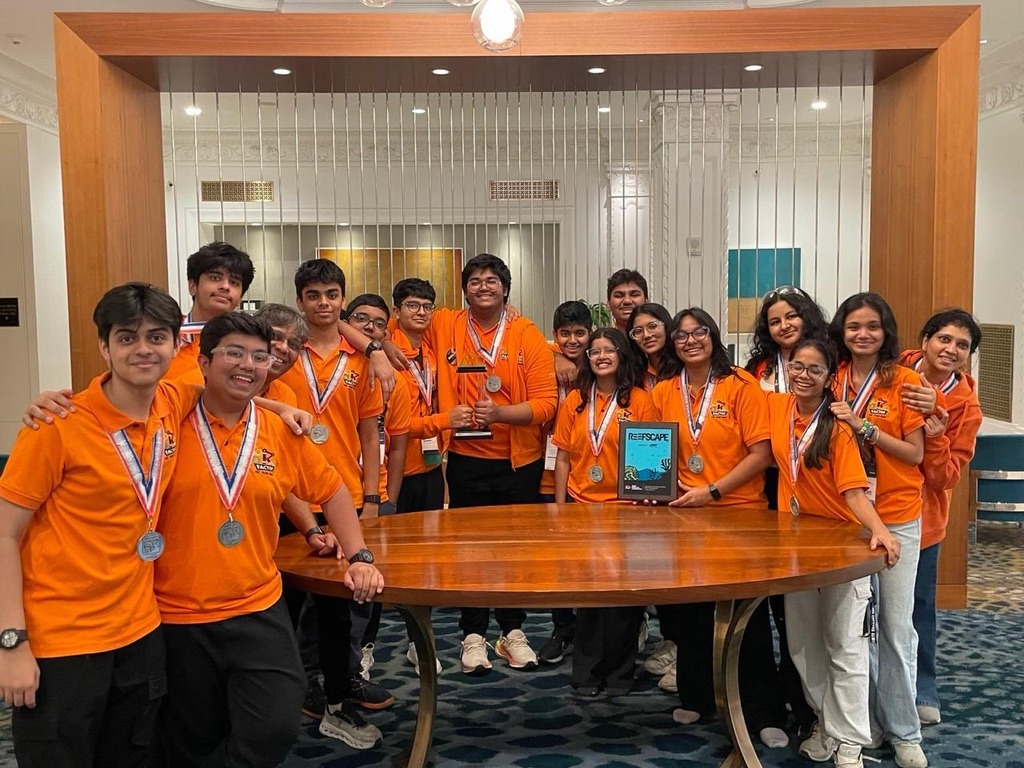
Team R Factor 6024 becomes the first Indian team to win the prestigious Engineering Inspiration Award. This achievement occurred at the Johnson Division FRC (FIRST Robotics Competition) Championships. The event was held in Houston from April 16th to 19th, 2025. This global event brought together over 640 FRC teams from 30+ countries, with more than 40,000 attendees.
This award celebrates outstanding success in advancing respect and appreciation for engineering within a team’s school, organization, and community. It recognizes passion, knowledge, and commitment to inspiring others to embrace science and technology.
The success of the team was well appreciated in multiple news articles
“You can read about my first year in FRC and how I joined Team RFactor 6024 here.”
Pingback: Contribution to FRC Robotics Team: Programming, CAD, and Prototyping - Sai Pranav | Student, Innovator, Leader